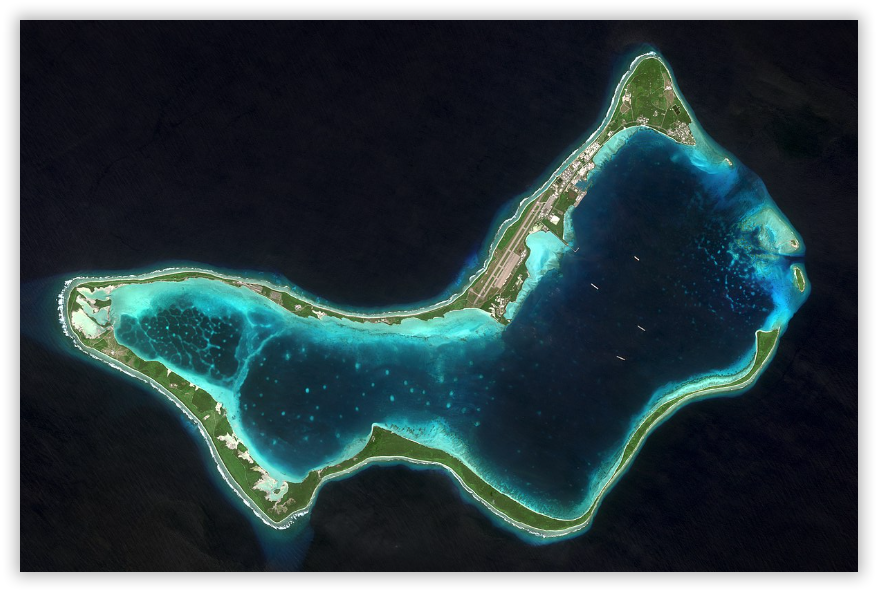
Image Source: Wikimedia Commons
Readers cannot have missed the recent news indicating a very significant shift: the United States is now distancing itself from the proposed transfer of Diego Garcia in the Indian Ocean to Mauritius, undermining earlier claims of consistent US support. However, this post examines consumer telecommunications services on the island and will not digress into these other extremely interesting aspects.
OpenFalklands has extensively covered telecommunications in the Falkland Islands, Ascension Island, and St Helena over the last few years, but readers may not be aware that Sure Diego Garcia Ltd. also provides consumer telecommunications services on the island of Diego Garcia.
To quote Sure’s Company Information page on their website:
“…with effect from 19 August 2013, we changed our name from Cable & Wireless (Diego Garcia) Limited to Sure International… As of 1 January 2017, Sure’s operations in the Channel Islands and Isle of Man and in the South Atlantic and Diego Garcia started to be managed as one group, headquartered in Guernsey.”
Sure provides consumer services to NGIS (Navy Gateway Inns & Suites), the Navy’s official lodging operation, and it’s the base’s hotel/billeting office and services for visitors/TDY personnel. It also serves the MWR (Morale, Welfare & Recreation), the program that runs recreation, fitness, trips/events, gear rental, clubs, etc., for personnel on the island. No Starlink service is permitted because of Sure’s exclusive licence; as a result, its consumer broadband service relies on geostationary satellites and suffers from high latency, as is also the case in the Falkland Islands.
The situation surrounding Diego Garcia is challenging to understand. In practice, the island continues to operate as a major UK–US military base, with the UK exercising day-to-day control over security, access, and communications. At the same time, the UK has agreed in principle to transfer sovereignty to Mauritius under a treaty that has not yet entered into force and that has become highly politically contentious. This leaves an awkward middle ground: day-to-day control continues, even as political backing weakens.
This ambiguity creates a sense of limbo. Diego Garcia is still run as if it were under British control, yet it is increasingly treated in official terms as territory the UK expects to give up. That unresolved tension now affects everything connected to the island, including its telecommunications infrastructure and the companies that maintain it, such as Sure International.
Sure’s role on Diego Garcia has always been highly specialised. The island has no civilian population and exists almost entirely to support military operations, so telecommunications there have never resembled a normal consumer market. Connectivity is designed to serve defence needs, is tightly controlled, and operates in a security-first environment shaped by UK and US priorities rather than by commercial demand. This has provided long-term stability in the past, but it has also meant that there has never been meaningful scope for significant commercial growth or competition.
The proposed UK–Mauritius agreement would formally transfer sovereignty to Mauritius while allowing the UK and US to retain extensive authority over Diego Garcia for defence purposes. In practical terms, this likely means that military communications would continue much as they do today. The problem lies outside that narrow military core. Anything that does not clearly fall within core military operations becomes harder to categorise, govern, and plan for, for example, consumer telecommunications services.
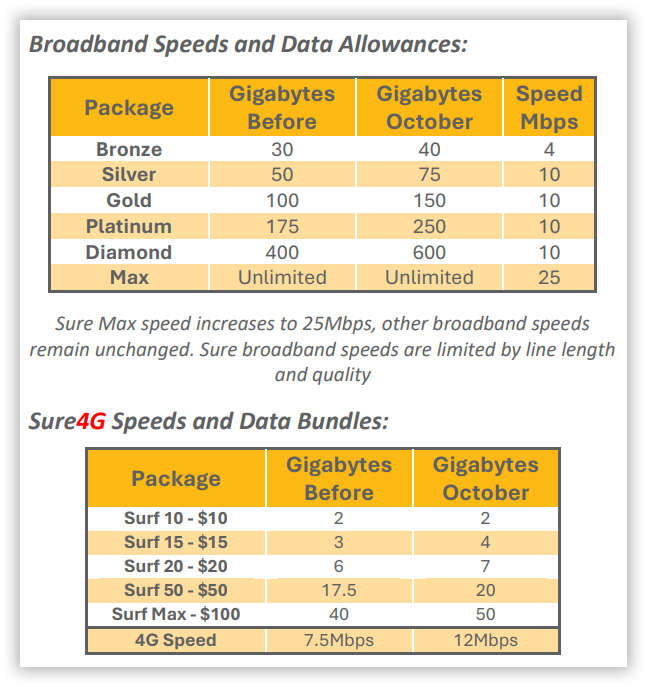
If sovereignty does eventually transfer, a new commercial dynamic is also likely to emerge. Mauritius Telecom, as Mauritius’s national operator, would have a strong incentive to take over or replace any consumer-facing telecommunications services linked to territory it considers sovereign. Even if current civilian services on Diego Garcia are minimal, the direction of travel could be clear. Any non-military telecoms activity would naturally fall under Mauritian commercial and regulatory control, leaving little room for an external operator like Sure beyond defence-linked functions.
Recent Reuters reporting adds another important dimension. It shows that Diego Garcia has quietly been connected to high-capacity undersea fibre-optic networks as part of broader US efforts to secure global data infrastructure amid growing competition with China. This confirms that the island’s importance is increasing. Its connectivity is becoming more valuable to military planners and national security agencies, not more open to commercial development or civilian use.
Core defence-related communications on Diego Garcia are therefore likely to continue much as they do today, tightly controlled by the UK and the United States and insulated from commercial pressures. Beyond that narrow sphere, however, the outlook is far less certain. Political ambiguity over sovereignty, combined with Mauritius’s clear strategic and commercial interests, leaves little prospect of a stable or expanding role for independent consumer telecoms provision. For Sure, Diego Garcia is unlikely ever to resemble a conventional market: its future presence will be constrained, contingent, and shaped overwhelmingly by geopolitics rather than by demand, growth, or competition.

Chris Gare, OpenFalklands, January 2026, copyright OpenFalklands