

A previous post titled “St Helena terrestrial fibre optic network disaster” discussed problems with St Helena’s terrestrial telecommunications network.
As of the start of 2026, the original exclusive telecommunications licence held by Sure South Atlantic in Saint Helena expired under its original terms, having reached its stated duration on 31 December 2025.
However, under the transitional provisions of the new Communications Ordinance, approved by the St Helena Legislative Council in June 2025, all licences issued to Sure South Atlantic under the Telecommunications Ordinance 1989 remain valid and in full force until 31 March 2026. Once under the new Ordinance, the licence exists only on the terms permitted by that Ordinance.
Sure therefore continues to provide mobile, fixed-line and Internet services on the island during this interim period. The new Ordinance states that “A 12-month notice period may apply in some circumstances but is not guaranteed, universal, and is not a right held by the operator regardless of conduct.”
This situation is the result of unsuccessful negotiations during 2024 and 2025 between Sure and the St Helena Government over a new long-term operating framework. Those talks were intended to modernise the relationship in light of St Helena’s connection to the Equiano submarine cable and long-standing concerns over pricing, service levels and consumer protection. While the new Communications Ordinance was approved, it does not replace Sure’s licence immediately; instead, it establishes a defined transition to a new regulatory framework.
The 9th January 2026 issue of the St Helena Independent states:
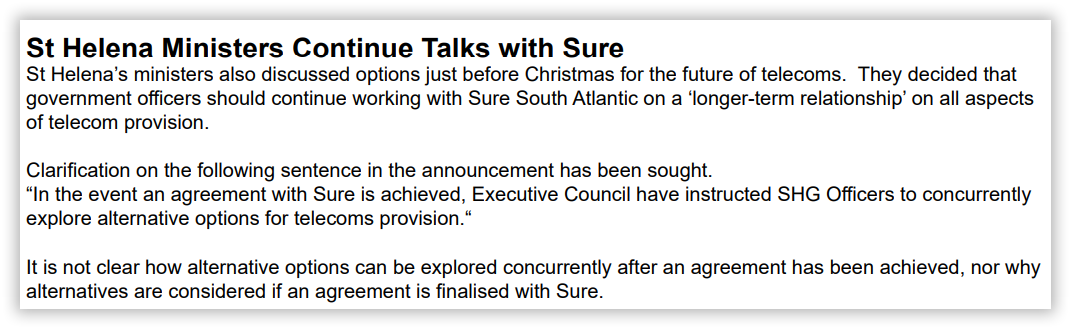
Until 31 March 2026, the terms, conditions, rights and obligations contained in Sure’s existing licences continue to be governed by the Telecommunications Ordinance 1989, notwithstanding its repeal. During this period, the old Ordinance continues to apply to the interpretation of the licences, the enforcement of licence conditions, any permitted modifications, and to any proceedings or enforcement actions already in progress. This provides legal continuity, but also confirms that St Helena remains, for the time being, within a legacy regulatory framework.
From 1 April 2026, Sure’s existing licences will be deemed to have been issued under the new Communications Ordinance. From that date, the new law will apply to licence interpretation, enforcement, modification and any ongoing proceedings. This marks the point at which regulatory authority fully transfers to the new framework, even if the underlying commercial arrangements remain unresolved.
This staged transition is not confined to relevance to St Helena alone. On Ascension Island, Sure South Atlantic has taken a more explicit stance, stating that it will withdraw from the island in February 2026, as covered in the previous OpenFalklands post. While Ascension’s strategic and defence context differs, both territories illustrate the same underlying dynamic: long-standing telecoms arrangements are being unwound, renegotiated, or legally re-based rather than quietly renewed.
For the Falkland Islands, the St Helena position is therefore instructive. Sure South Atlantic in St Helena, working under similar geographic and economic constraints, is now operating through a defined post-expiry transition rather than a settled long-term licence.
The St Helena model shows that licence expiry does not necessarily produce an immediate service cliff-edge, but instead a prolonged period of legal and regulatory, as well as commercial, realignment and the consequential uncertainty.
Taken together with developments on Ascension Island, St Helena’s transitional arrangements underline a broader shift in South Atlantic telecommunications. The era of indefinite exclusivity has ended; what replaces it is proving slower and is far more contested. For the Falklands, where connectivity, resilience and strategic autonomy are central concerns, these developments elsewhere in the region offer a clear and increasingly relevant point of comparison.
The St Helena situation shows that governments face challenges in achieving improved outcomes once legacy arrangements unwind. For Falklands consumers and businesses, the key concern is not so much an abrupt loss of service, but the possibility of prolonged uncertainty, limited competition, and slow reform, all of which can affect affordability, quality, and the resilience of telecommunication services.
At the same time, prolonged licence transition and unresolved commercial arrangements risk weakening investment incentives, as an incumbent operator has little reason to commit capital to network upgrades or resilience improvements while long-term terms remain uncertain. In this context, the challenge for the St Helena Government and, by implication, the Falkland Islands Government, is not only to end legacy exclusivity but also to ensure that reform translates into tangible improvements for consumers and businesses.

Chris Gare, OpenFalklands, January 2026, copyright OpenFalklands
St Helena over many years, or should I say its Government or whoever really commands power, has been adeptly resistant to external advice in all kinds of areas that is, apart from their own or FCDO commissioned sources. We always had the impression the Falklands was managing to be less hidebound despite its reliance on the UK for defence.
I think that what has also emerged in the telecommunications field is that there are external independent people suitably well-qualified able to provide equally valid opinions. And maybe gradually the old colonial “we know best mindsets” are beginning to accept them. In that regard you are doing a great job, especially if it opens up similar opportunities in those other areas at long last.