

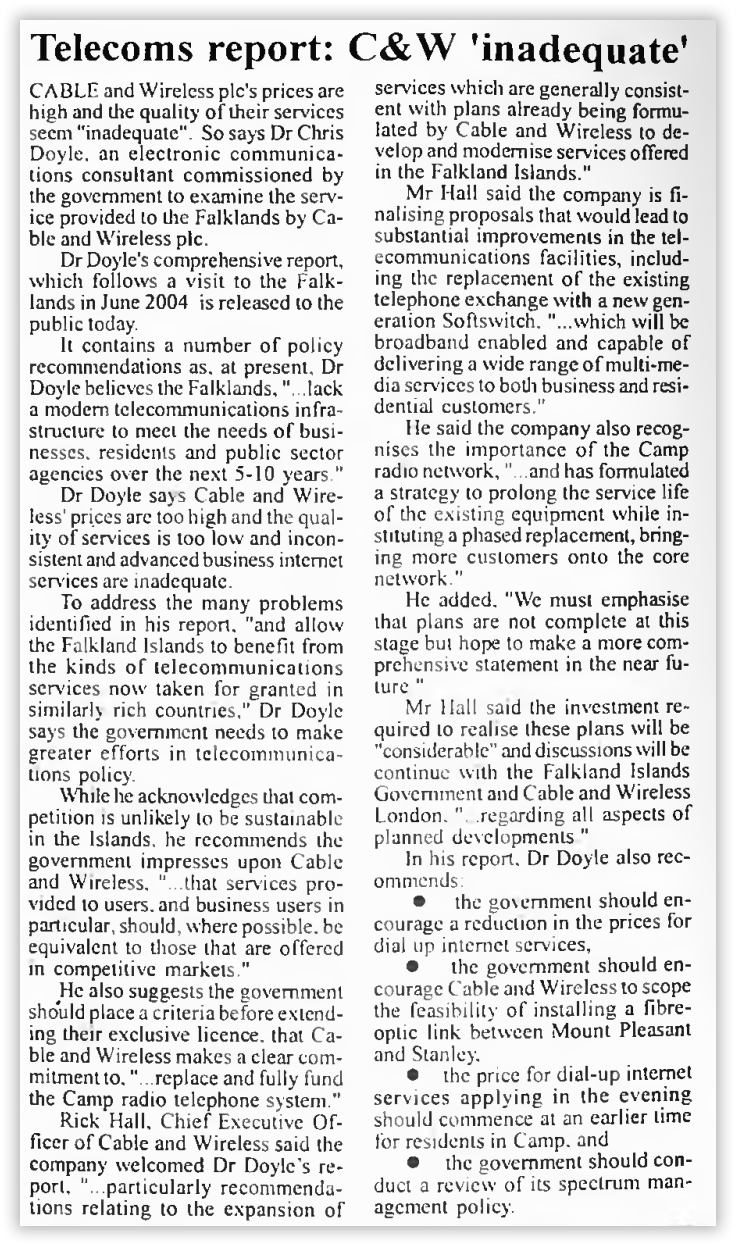
In 2004, the Falkland Islands Government (FIG) commissioned an independent review of telecommunications to assess proposals from Cable and Wireless (C&W) to upgrade the Camp communications system and to consider the sector’s future direction. The report, written by Dr Chris Doyle of Warwick Business School and published in January 2005, examined the structure, performance and regulation of telecommunications across the Islands and set out policy recommendations for the years ahead. A redacted public version was published in February 2005. We should remember that in the 20 years since this report was written, the technology scene has changed dramatically, as demonstrated by the advent of Starlink.
At the time, telecommunications in the Falkland Islands operated under a legal monopoly held by C&W. This exclusive licence had originally been designed to support investment in a modern network, but it also meant that a single operator controlled all public services. Although C&W has since been replaced by Sure International, the market’s underlying structure remains largely unchanged. The Falklands is still a small, remote and potentially high-cost telecommunications environment.
This post focuses on the key problems identified in the 2005 report. Many of these same issues remain today, not simply because of inaction, but because they are rooted in the economic and geographic realities of the Islands.
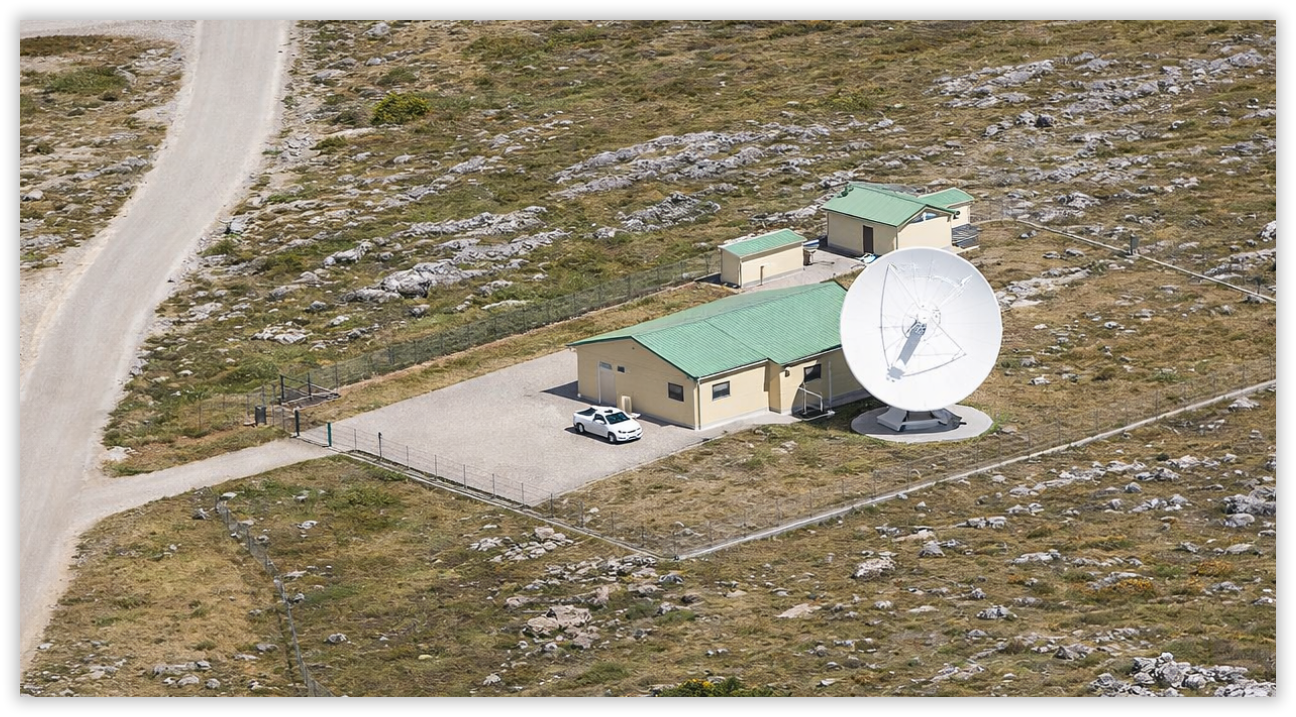
The C&W earth station in 2004.
One of the main findings was that telecommunications prices were high. With no competitive pressure, the monopoly provider had limited incentive to reduce tariffs. This situation has not fundamentally changed. The small population limits economies of scale, infrastructure costs remain high, and a single operator continues to play a dominant role in the market.
The report also highlighted problems with the quality of service (QoS). While voice telephony was generally adequate, broadband Internet services were poor and inconsistent, particularly in Camp. Slow speeds and unreliable connections limited the ability to support education, healthcare, and business needs. The island’s total broadband satellite capacity was 2 Mbit/s in 2004!.
A further stated issue was the lack of modern generation infrastructure even then. At the time, there was extremely limited broadband capability, no mobile network and key parts of the system were approaching obsolescence. Although there have been many developments since then, the underlying constraints remain similar. Investment is expensive, the market is small, and progress depends heavily on the scale and timing of investment decisions. Internet provision was a particular concern. Access was slow, expensive and unable to meet growing demand.
The absence of competition was identified as a central issue. The report recognised that telecommunications in the Falklands functions largely as a natural monopoly, given the market’s size and cost structure. While this broadly remains true, there have been some important developments in recent years. The introduction of a telecoms regulator and the emergence of alternative broadband services such as Starlink indicate that some degree of competition, particularly in broadband, is now available. However, the market as a whole remains characterised by a single primary operator.
Finally, the report pointed to limited regulatory oversight. There was insufficient scrutiny of pricing, performance and profitability, and a need for a more active role from the FIG. This has evolved over time, with the creation of a Communications Regulator in the islands.
Taken together, these findings highlight a consistent reality. The same fundamental constraints identified in 2005 still apply today. The Falklands remains a small, isolated and high-cost environment, and these conditions continue to shape the telecommunications sector.
As a result, many of the original problems remain familiar. Prices remain relatively high, service improvements are gradual, infrastructure upgrades are costly, and competition is limited in scope. These are not simply policy failures but reflect the structural challenges of providing telecommunications in a remote island economy.
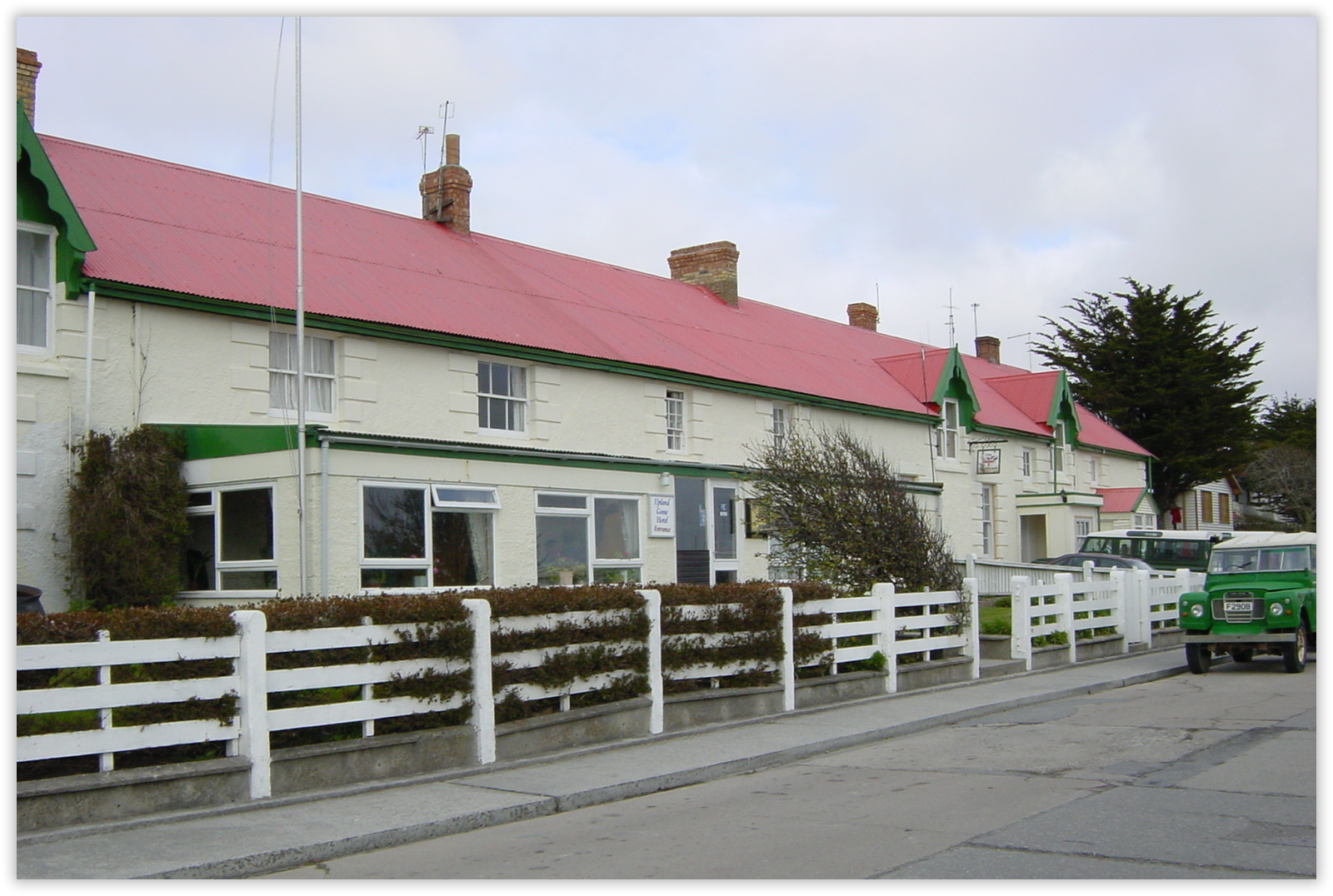
The Upland Goose Hotel in 2005.
Chris Doyle’s 2005 Recommendations
The report did not suggest introducing full competition, recognising that the Falklands is too small and remote for multiple telecoms companies to operate efficiently. Instead, it focused on how FIG could use its existing powers more effectively to improve services. It recommended using the renewal of the monopoly licence to push for better performance, making any extension conditional on lower prices, improved service, and new investment.
A stronger and more transparent regulatory approach was also proposed. This included requiring the telecoms provider to publish regular reports on prices, service quality and future plans, and allowing the FIG to compare performance with other places. The aim was to ensure that customers were getting a fair deal.
The report also highlighted the need for better infrastructure, especially in Camp, where the existing system was already becoming outdated. It suggested replacing it with a modern system capable of supporting faster Internet, with some FIG funding likely needed due to the high costs.
Improving internet access was a key priority. At the time, services were slow and expensive, so the report called for lower prices, faster speeds and better access for both residents and businesses. It also recommended introducing mobile phone services, even if only in the most densely populated areas, and improving connectivity for key industries such as fishing and tourism.
Overall, the message was simple. If full competition is not realistic, then FIG needs to take a more active role in ensuring people receive better services, fair prices, and long-term investment in the Islands’ communications.

Chris Gare, OpenFalklands, March 2026, copyright OpenFalklands

3 Replies to “2005 Telecommunications in the Falklands: The Same Challenges, Twenty Years On”