
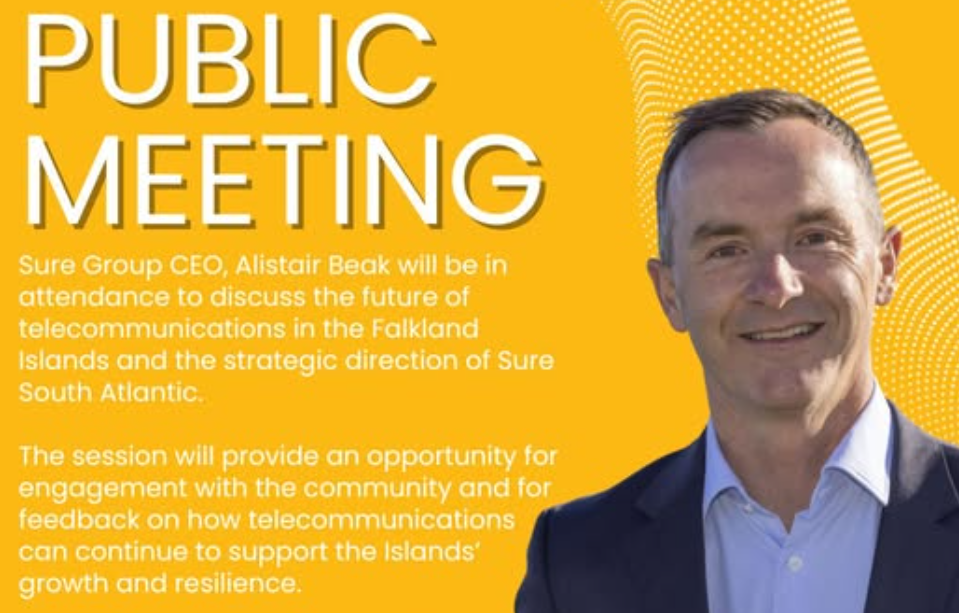
I would like to thank FIRS and FITV for letting me have recordings of the public meeting held by Alistair Beak, the CEO of Sure South Atlantic, on Wednesday, 22nd April 2026. Roma Stewart, CEO of Sure Falkland Islands, was also in attendance. Please find below the 1-hour 25-minute recording and an OpenFalklands analysis of some of the significant points raised in the discussion.
Here is the recording – enjoy the debate!
The tone of Wednesday’s public session was markedly different from the CEO’s visit in March 2025. Rather than arriving with a prepared set of announcements, Alistair Beak opened by saying he wanted less presentation and more discussion, and he largely delivered on that. The audience was engaged, at times challenging, and the CEO handled criticism without becoming defensive. One participant captured the mood well, observing that it felt like the first time the local operator and its customers were genuinely on the same page. That is a significant observation from a community that has had good reason to be frustrated. The residual tensions around Camp service reliability, CapEx constraints, and financial transparency have not disappeared. But the overall atmosphere was constructive, and the conversation felt like that of a company that has accepted the ground has shifted rather than one still trying to defend the status quo.
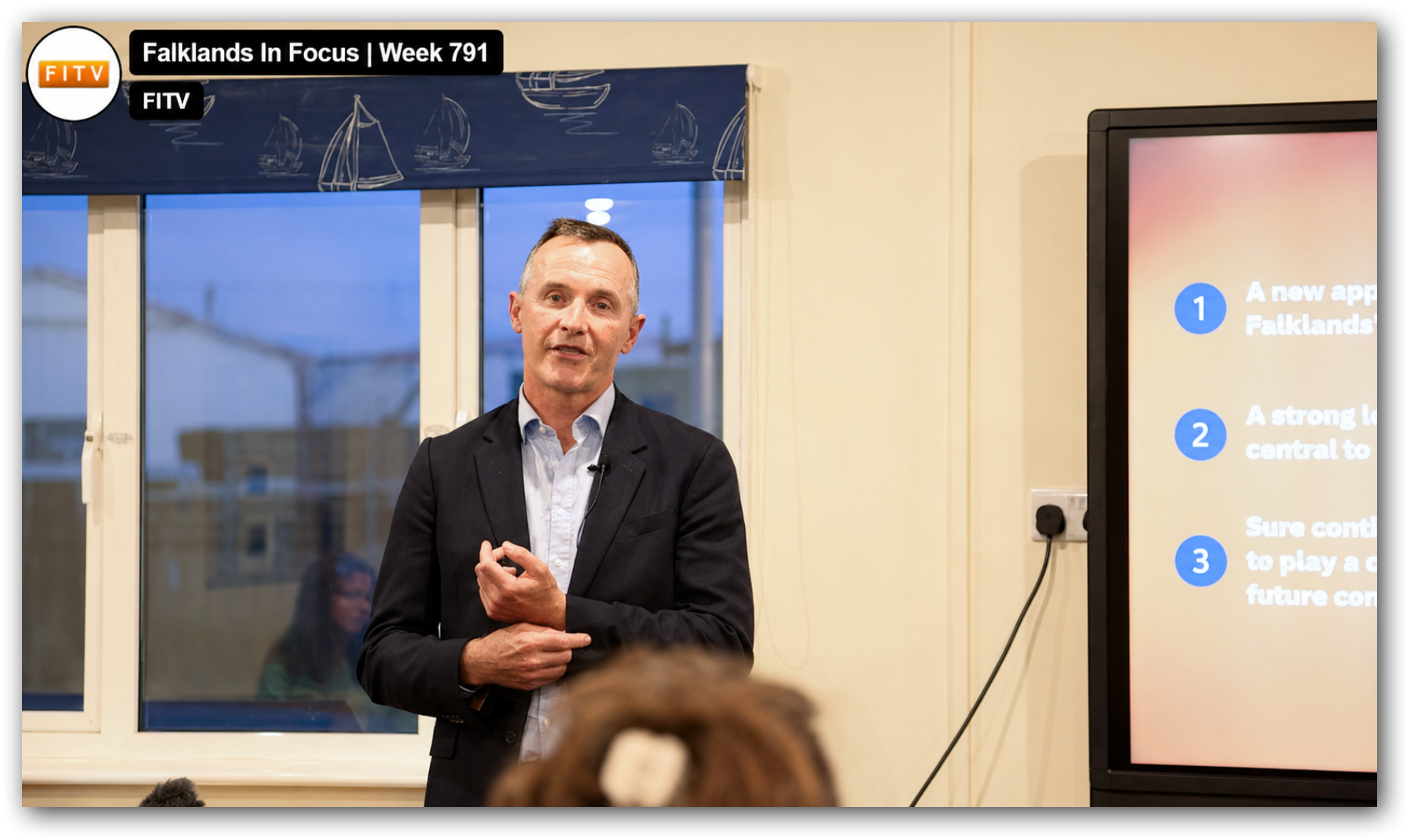
“Thank you all for attending. It’s great to see so many of you here. For those who don’t know me, my name is Alistair Beak, CEO of Sure. This is my fourth visit to the Falkland Islands, and I’ve been coming more regularly over the past few years. It’s fantastic to be back, particularly in this room where we’ve had many discussions about telecommunications.”
When Alistair Beak visited the Falkland Islands in March 2025, he made bold and specific public commitments. Two new unlimited broadband services would replace all existing packages, priced at £50 and £115 per month. A low-latency LEO service based on OneWeb would be rolled out, prioritised for Camp customers. The team was working flat out. He stated that Islanders really did have Sure’s attention.
An Admission That Things Need to Change
The most significant moment in the presentation came early. The CEO openly acknowledged that technology had moved faster than Sure had anticipated when the current licence was put together in 2016 and 2017. He conceded that a gap had opened between what Sure could offer as a local provider and what people could access through globally available technology. He said a whole new approach was needed, not just from Sure, but in how telecommunications in the Falklands are structured and regulated going forward.
This is a meaningful admission. For years, the OpenFalklands narrative has been that Sure’s monopoly model was falling behind technological reality. Hearing the CEO say that directly, in public, to a room of Falklands businesses, represents a genuine shift in tone.
OneWeb: Effectively Written Off
One of the more striking moments was the CEO’s candid assessment of OneWeb. Having presented it in March 2025 as a key part of Sure’s future offering for Camp customers, he now acknowledged that, in hindsight, it was never suited to mass-market provision. It is too expensive, too power-hungry, and less reliable than Starlink. He suggested it retains value for government or defence customers with data sovereignty concerns, but for consumer use, the case has largely collapsed. He noted that Sure has not seen the demand it anticipated.
This is a significant climbdown. The OneWeb service was first announced in a joint press release in November 2022. By the time of the March 2025 presentations, it had still not launched. Now, some two and a half years after that original announcement, the CEO is effectively conceding that it will not become the mass market product it was presented as. Islanders who were asked to wait for it deserve a clearer acknowledgement of that than they received.
Starlink Congestion Concerns Quietly Walked Back
The CEO was challenged directly on Sure’s previous warnings that widespread Starlink adoption would lead to network congestion. His response was notably more measured than the position Sure took during the Select Committee process. He acknowledged that Starlink has continued to add satellites, that coverage over the Falklands is now provided by multiple satellites simultaneously, and that the congestion risk has diminished as a result. He stopped well short of retracting the earlier warnings, framing them as reasonable at the time, but the practical effect of his answer was to concede that the picture has changed substantially. His 2025 position appeared to have conflicted with positive global views of Starlink at the time.
This matters because those congestion warnings formed part of Sure’s case against Starlink’s approval. The CEO did not acknowledge that directly, but the audience will have drawn their own conclusions that he was wrong.
The Compensation Payment
The CEO confirmed that Sure is receiving compensation from FIG in connection with the Starlink approval and that the total received will probably be lower than the publicly cited maximum. The reason, he explained, is that fewer people than anticipated have switched away from Sure, meaning the revenue impact has been less severe than the worst-case scenario. He framed this positively, as evidence that Sure retains customer loyalty.
It is worth noting, however, that the compensation arrangement itself, understood to total up to £6 million through to the end of the current licence, remains a significant public financial commitment. The fact that the final figure will be lower is welcome, but the existence of such a payment in the first place reflects the complexity and cost of the transition that Sure’s resistance to Starlink made necessary.
A More Open Vision for the Future
Perhaps the most genuinely encouraging part of the presentation was the CEO’s discussion of the future. He explicitly endorsed a public-private partnership for infrastructure investment, suggesting that a model in which the government co-invests in fibre or fibre-equivalent infrastructure in Stanley, with Sure as the operator, could be the right approach. He discussed the possibility of working with Starlink, Amazon Kuiper and AST SpaceMobile for backhaul and mobile coverage extension across the Islands, including in Camp. When pressed, he confirmed that Sure is in active senior-level discussions with all three providers, as expected.
He also made it clear that Sure is not seeking a ten-year licence on the same terms as before. He acknowledged the need for built-in review mechanisms, competitive checks, and a regulatory framework that responds to technological change. He floated the idea of a three-year review window in any future licence arrangement, allowing performance to be assessed and course corrections to be made.
These are not trivial concessions. They represent a meaningful shift from the defensive, opaque posture that characterised much of Sure’s engagement during the Starlink petition process. The CEO’s willingness to openly discuss partnership models, infrastructure co-investment, and working with competing satellite providers in a room full of Falklands businesses is on a different register entirely from March 2025.
What Remains Unresolved
For all the more constructive tone, several important questions were not answered.
The specific promises of March 2025, unlimited broadband for all at £50 and £115 per month, and an imminent OneWeb launch, were not acknowledged as having fallen short. The unlimited services that arrived in January 2026 cost £50 and £115 per month, as promised in March 2025. That is to be acknowledged. But it took nine months longer than the confident presentation suggested, arrived only after Starlink had already transformed the competitive landscape, and the OneWeb element fell considerably short of the promises.
The financial transparency question also remains open. Sure’s estimated net profit margins for the Falklands have run at around 29% over the past decade, well above industry norms, with substantial dividend payments to parent company Beyon. The CEO’s March 2025 claim that Starlink would make the business unsustainable has never been supported by independently verified financial data. That was not addressed this week either.
And while the CEO spoke warmly about local staff and community involvement, the audience heard directly from customers who had received letters stating their issues could not be resolved due to a lack of investment approval, and about Camp infrastructure that has been experiencing faults for years without resolution. Those are not abstract concerns. They are the lived experience of people in the room.
An ‘Honest’ Assessment
This was a better presentation than the one in March 2025. The CEO was more candid, more open to challenge, and more willing to acknowledge that the current model has run its course. The vision he outlined for the future, a local operator anchoring a hybrid system that draws on LEO satellite technology, complemented by upgraded local fixed and mobile infrastructure, with public-private investment and built-in regulatory checks, is broadly consistent with what OpenFalklands has been arguing for.
The question is whether this vision will be followed by action, or whether it will follow the pattern of March 2025, where confident words were not always matched by delivery. The community has reason to be cautiously encouraged, and equal reason to want specifics rather than a general direction of travel.
The CEO said something telling near the end of the session. He suggested that for the first time, the local operator and customers are on the same page, trying to take advantage of the same technology. That may well be true. But trust, once lost, is rebuilt through consistent action over time, not through a presentation, however well-received.
The licence expires on 31 December 2027. The window for giving formal notice has been open since January 2026. FIG and MLAs now have the CMC report in hand and a clearer sense of what Sure is prepared to offer. The next move is theirs. More on this soon.
To quote the CEO – “A whole new different approach needs to be taken. I think a whole new different approach by Sure as an operator if we’re lucky enough to be an operator here in the Falklands in the future.”
Let’s hope for this change and push for this to take place. Either way, OpenFalklands will continue to follow developments closely.

Chris Gare, OpenFalklands, April 2026, copyright OpenFalklands
I’m delighted to hear that Sure has now acknowledged the reality of the seismic change that Starlink has brought to the Falklands.
According to the Communications Regulator, there are some 1400 pVSAT licences in place now, and Sure still concedes that they still have a viable market here.
I maintain that for Sure to remain relevant, they MUST instigate Wi-Fi assisted calling as a priority task. Look at the UK, mobile and broadband have all but replaced POTS connectivity.
Since Sure’s CEO also concedes that the whole telecommunications market here has been changed beyond all recognition, FIG needs to give formal notice that the existing contract will come to an end. I struggle to understand why FIG would not send this notice, at this time. What signal do they think this sends to Sure and to the population that asked for change?
That’s interesting to hear about the meeting recordings. It seems like a significant development regarding the ongoing discussions about Sure’s involvement in the Falkland Islands.