
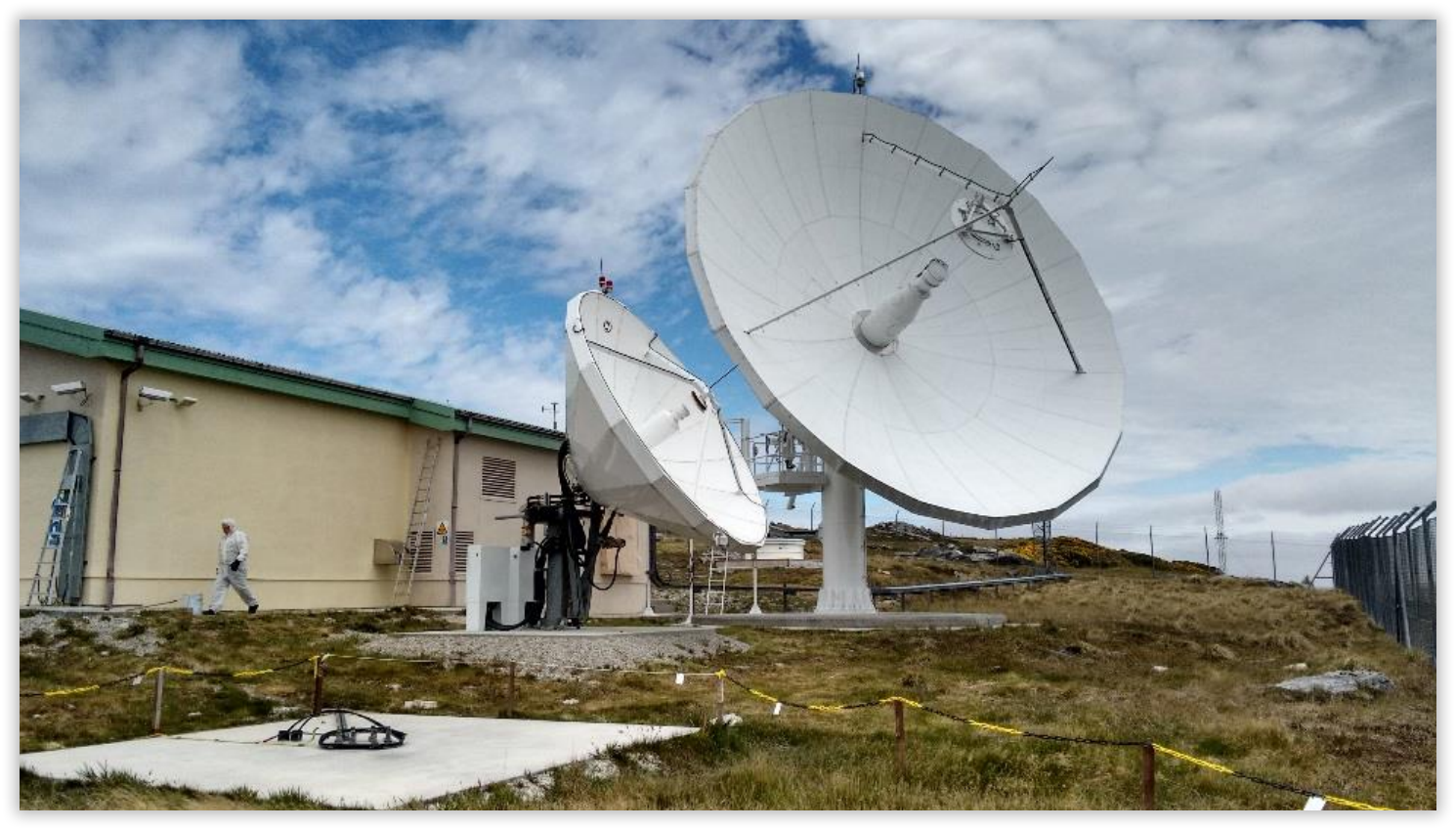
Sure’s Earth Station in 2015
In the previous OpenFalklands post, we focused on Chris Doyle’s 2005 review of Falkland Islands telecommunications. Ten years on, in 2014, the Falkland Islands Government commissioned a further strategic review – Part A: Landscape Report of telecommunications to assess the sector’s performance and inform future decisions on licensing, regulation and investment. The public version of this report was issued in March 2015. There was no public version of Part B: Technical and Regulatory Recommendations, although its recommendations were widely discussed. However, it was finally approved for public release in November 2016.
The work was carried out by consultants Cartesian, in partnership with Preiskel and Co in 2015 following consultation with the Falkland Islands Government (FIG), businesses, and the wider community.
By this point, ownership of the telecommunications provider had already changed, with Sure International (Sure) having acquired the business from Cable and Wireless (C&W) in 2013. However, the market’s underlying structure remained largely unchanged, with Sure continuing to operate under the old C&W exclusive licence. The review, therefore, focused not only on technical performance but also on whether the existing regulatory approach was delivering the outcomes expected.
The work was carried out by UK consultants Cartesian, in partnership with Preiskel and Co, following consultation with the Falkland Islands Government (FIG), businesses and the wider community.
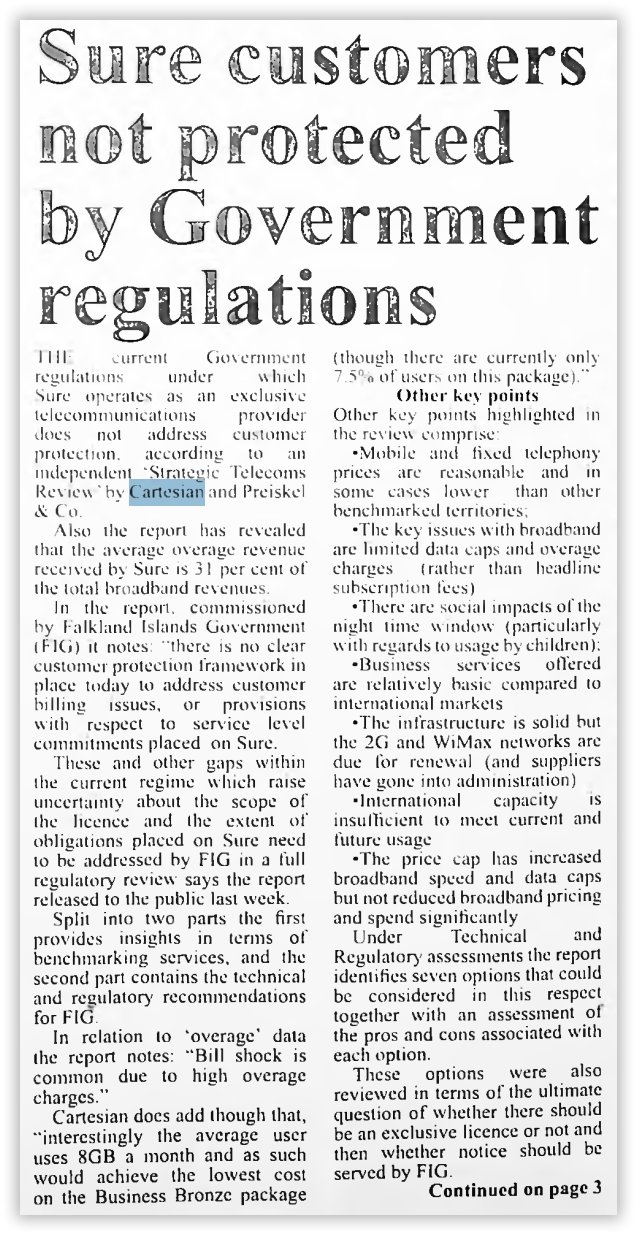
As with the 2005 Chris Doyle report, the review identified several key issues. The most significant was broadband. While headline prices were not considered unusually high, the way services were structured meant that many users faced high additional charges once they exceeded their data limits. This led to what was described as “bill shock”, with customers regularly paying more than expected if they exceeded their monthly allowance.
The report also highlighted the social impact of service delivery. The availability of free usage during nighttime hours had encouraged people, including children, to use the internet at unsociable times. While this approach helped reduce costs, it created unintended consequences for daily life and wellbeing.
Infrastructure was assessed more positively than in earlier years. The network was considered broadly sound, with full coverage for fixed services and high population coverage for mobile. However, there were clear concerns about ageing systems. Both the mobile network and the wireless system used in Camp were approaching the end of their life and would require replacement in the near future. In many respects, this reflected issues already identified in 2005.

Sure’s Camp Customer Premises Equipment in 2015
A further major issue was international connectivity. Although capacity had increased, it remained insufficient to meet growing demand. By 2014, island-wide satellite capacity had increased to 50 Mbit/s, up from 2 Mbit/s in 2005. However, this was still a key constraint affecting both performance and pricing, as limited capacity contributed directly to high usage charges. Without significant expansion of international bandwidth, many of the other issues could not be fully addressed.
The review also pointed to gaps in the regulatory framework. While some measures, such as price controls, had been introduced, they had not achieved the intended reductions. In some cases, the system allowed prices to rise while still remaining within the rules. More broadly, there was a lack of clarity regarding customer protection, service standards, and investment responsibilities.
Business services were another area of concern. While basic services were available, they were limited compared with those offered elsewhere. This was increasingly important given the needs of key sectors such as fisheries, tourism and potential oil and gas development, all of which depend on reliable, high-quality connectivity.
The question of competition was again considered. As in the earlier report, the review recognised that the Falklands is a small and geographically challenging market, making full infrastructure competition difficult. However, it also explored whether changes to licensing and regulation could introduce more competitive pressure or alternative solutions in specific areas.

The 2015 report’s main recommendations
The 2015 review did not recommend moving away from the existing exclusivity model, but instead set out practical steps to improve services, regulation and long-term investment.
The report examined the operator’s financial performance, noting relatively high returns and a perception among some users that prices were not aligned with costs, further reinforcing concerns about value for money.
A central recommendation was to significantly increase international connectivity. Limited bandwidth was identified as the root cause of many problems, particularly high data costs and restricted usage. The report proposed expanding satellite capacity, potentially through a combination of technologies, to enable higher data allowances and improved performance.
The report also recommended upgrading the mobile and Camp networks. Both were approaching the end of their life, with a shift to newer technology, including modern 4G mobile broadband, starting in Stanley and Mount Pleasant and extending to Camp over time.
Alongside this, it highlighted the need to reform broadband pricing. Pricing should better reflect actual usage, with less reliance on high overage charges, reducing bill shock and making services more predictable for households and businesses.
A further recommendation was to update the regulatory framework. The system was seen as outdated, with gaps in customer protection, service standards and the adoption of newer technologies. A clearer, more modern approach was needed, with stronger oversight and defined obligations for the operator. While the report did not explicitly recommend creating a Communications Regulator, this can be seen as a natural outcome of the weaknesses identified in the existing regulatory regime. It is worth noting that a new Communications Ordinance was drafted in 2016 following the report.
The review also stressed the need to link licence decisions to investment commitments. Any future agreement should be conditional on delivering improvements, particularly in international capacity and network upgrades, reflecting a more active use of regulation.
In addition, it encouraged greater innovation in services, especially for businesses, including expanding product offerings and improving support for sectors such as fisheries, tourism and emerging industries.
Finally, while full competition was not considered realistic, the report explored introducing limited forms of competitive pressure, particularly in broadband or satellite services. It is worth remembering that LEO satellite services, such as Starlink, were still in their early stages in 2015.
Overall, the message was clear. Where traditional competition is limited, improvements must come from targeted investment, stronger regulation and clearer expectations placed on the operator.
FIG’s November 2016 Public Meeting
A FIG public meeting to present the consequences of the Cartesian report was held on the 14th November 2016, the full set of FIG slides of which can be seen here – Telecoms Public Meeting slides
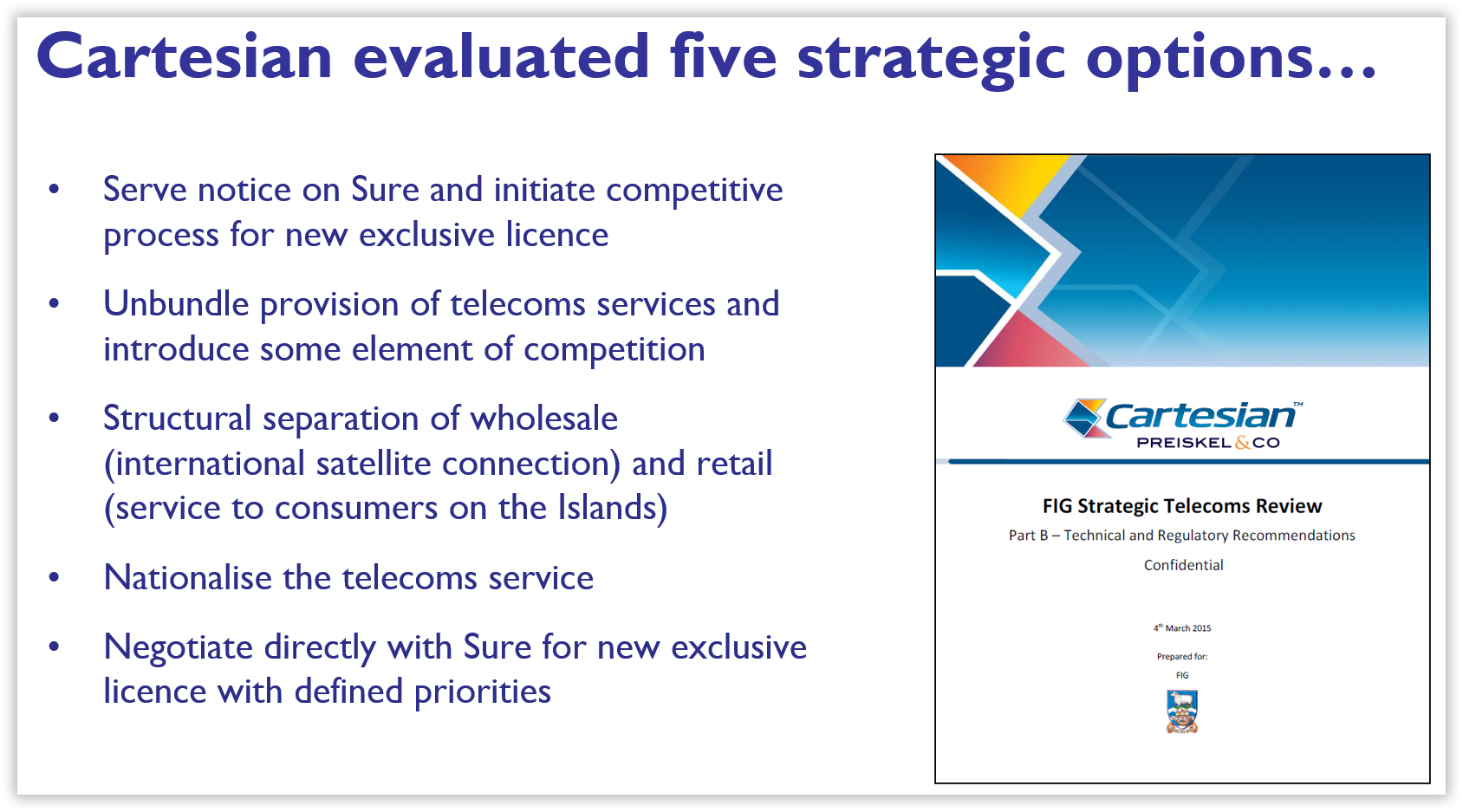
It is worth noting that the five “strategic options” identified in 2015 remain broadly applicable in 2026 and that FIG ultimately adopted in 2016 was the final one: to continue the Exclusive Licence for Sure International to provide telecommunications in the Falkland Islands. Sure was to be charged an annual fee of only £20,000 per year for its exclusive licence.
Conclusions
Taken together, the 2015 review presented a more detailed and technically informed picture of Falkland Islands telecommunications. It confirmed that while some progress had been made since 2005, many of the underlying challenges remained. In particular, the combination of limited international capacity, high effective costs for broadband users and an evolving but still incomplete regulatory framework continued to shape telecommunications in the Islands.
These findings reinforced a familiar conclusion. The constraints of scale, geography and cost remain central to understanding telecommunications in the Falklands. While the context had evolved, the core issues identified a decade earlier had not fully gone away.
The next post will look at one of the major activities that followed the 2015 report: the creation of the impactful 2016/2019 Amended Communications Ordinance.
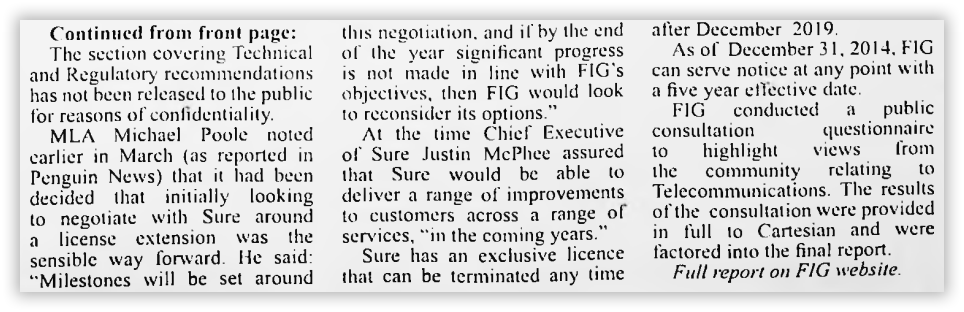
Penguin News – April 2nd 2015
Chris Gare, OpenFalklands, March 2026, copyright OpenFalklands
3 Replies to “2015 Telecommunications in the Falklands: The Same Challenges, Ten Years On”