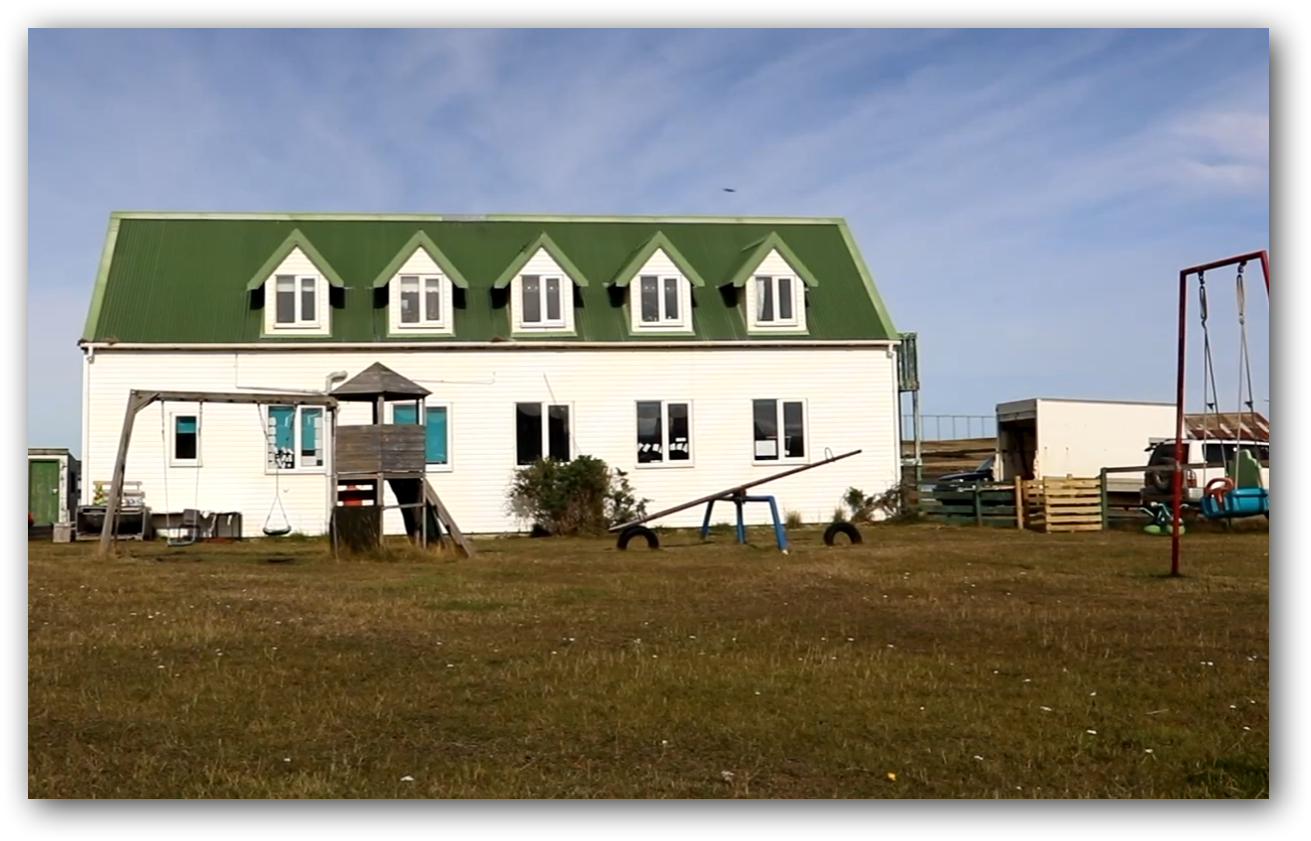
Image: Goose Green’s settlement school (Credit: FITV)
I am pleased to publish the following guest post from Andy Trish, following his recent October 2026 visit to the Falkland Islands.
Andy has been involved in technology and education for many years and, during his visit, spent time in the Islands’ schools talking with some of those who educate Falklands children. Indeed, Andy made education the main focus of his submission to the Starlink Select Committee back in August 2024.
“Schools, particularly in Camp, struggle with inadequate internet access provided by the Islands current suppliers. Every visit I have made to the schools in Camp show to me the dedication of the teachers and parents in ensuring the children get the very best experience given the tools available to them. Unfortunately the number one tool (fast and unlimited internet access) remains elusive.
Globally children and adults benefit from the interaction on websites, chat rooms, software usage, security, backups and many other services available to them, using Starlink or a comparative service would allow this on the Islands. Children are not the only people to benefit, teachers and staff could reliably attend training from educational bodies, they could share work from each school or home, mark homework and would feel a part of a team rather than out on their own. Many teachers come from abroad and fast, reliable internet access would allow them more interaction with home making them feel more settled.
I am currently in the process of donating Ipads to each child in Camp schools and by allowing Starlink I would be assured each Apple application would work as it was meant to and children would get the best use of them. When I donated Interactive screens to each Camp school I was aware that using Sure internet the updates were either not done due to their size or were problematic. At the same time I tried to introduce a means for all the schools to use an educational based intranet which I had persuaded the company to provide free of charge but to this day that software which was cloud hosted can’t use the service provided by Sure for bandwidth and latency reasons so the idea was abandoned.”
On his recent visit, he was surprised that, almost a year after the changes that opened the door to licensed Starlink services in the Islands, the schools he visited still weren’t using Starlink.
That raises a question which goes beyond broadband speeds or telecommunications policy. If significantly better connectivity is now available in the Falklands, is the Falkland Islands Government (FIG) using it enough where it can have the greatest long-term impact – in the education of the Islands’ children?
A recent FITV overview of Camp education provides some useful additional context. Sarah Stannard, FIG Director of Education, discusses the use of Starlink in Camp schools at around 1:35.
Andy sets out his thoughts below.

A Guest Post from Andy Trish
On my recent return to the Falkland Islands, I visited the schools and spoke with people working to give the Islands’ children the best possible education. I came away impressed by their commitment, but shocked to discover that the schools I visited still did not have Starlink.
Having spent much of my working life supporting schools with technology, I know what good connectivity makes possible. I also know how much time, effort and opportunity can be lost when the connection cannot support what teachers and children need to do.
The distinction between government and public access matters here. The Government has long benefited from exemptions within the communications legislation, including an exemption under section 24 for activities undertaken by or on its behalf. Its position has therefore been different from that of residents facing the restrictive personal VSAT licensing regime. The public’s licensing difficulties cannot simply be offered as an explanation for the absence of Starlink in government schools.
There were separate questions about Starlink’s approval as a provider, but the Government announced the agreement paving the way for that licensing on 30 October 2025. Almost a year later, my visit left me asking why education had not benefited more visibly from this opportunity.
This concern has been raised before. In my submission to the Select Committee in 2024, I described the difficulties facing Camp schools, including problems updating interactive screens and the abandonment of a proposed cloud-based educational platform because the connection could not support it. The educational case for better connectivity was already on the record more than two years ago.
Consider what the past year could have offered. Children could have joined live sessions with museums, scientists, authors and other schools. Teachers could have made greater use of interactive resources, shared projects and online learning tools. Pupils needing additional help could have had more opportunities to connect with specialist support beyond the Islands.
For children in Camp, the possibilities are particularly significant. A dependable connection could help small groups learn together across considerable distances, join lessons with classmates elsewhere and take part in activities that would otherwise require travel. It could give an isolated classroom access to a much wider educational community.
Stanley’s children deserve those opportunities too. A class researching a subject, using online design software or working together on a digital project needs a connection that can support the whole lesson. Teachers should be able to choose resources for their educational value with confidence that the technology will work.
The benefits extend to staff. Reliable access to training, professional networks and specialist colleagues can help teachers develop their skills and feel better supported. When the Islands work hard to recruit good teachers, giving them the tools to succeed should be part of the commitment made to them.
A year is a substantial part of a child’s education. For a pupil approaching examinations, it may be the final opportunity to build confidence in a subject. For a younger child, it could be the year a conversation with a scientist or a shared project with another school sparks a lasting interest. We cannot measure every opportunity missed, but we should recognise that time lost in education matters.

Port Howard School (Credit: FITV)
Installing Starlink requires proper planning: suitable equipment, secure networks, filtering, safeguarding and ongoing support. Those are practical requirements that should be addressed through a funded programme with clear responsibility and dates. The Government should explain what has delayed school installations, what provision each school currently receives and when improvements will reach children across Stanley and Camp.
My affection for the Falklands is precisely why I feel strongly about this. The Islands have talented children, dedicated teachers and a community that cares deeply about its future. Their ambition deserves infrastructure that helps them achieve it.
The past year could have been used to connect classrooms, support teachers and open more doors for children across the Islands. We should now be asking for a clear delivery timetable. Children get one chance at each school year. We owe it to them to make the next one count.
Andy Trish
Chris Gare, OpenFalklands, October 2026, copyright OpenFalklands