
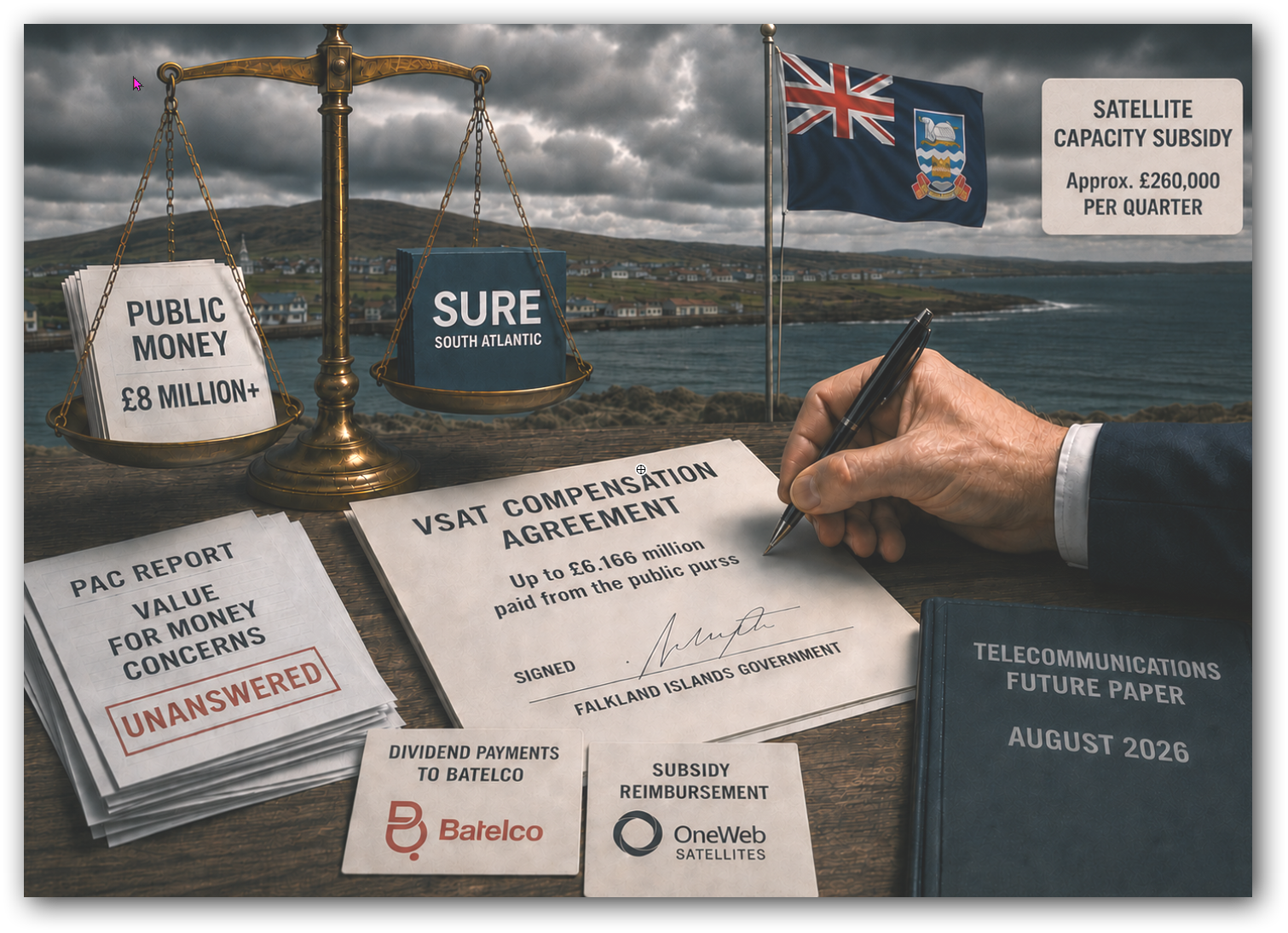
Please note that this is an AI-generated image.
PDF version of the six posts – The case for a Telecommunications Select Committee
The headline points for busy readers
This post is not about what the Falkland Islands Government (FIG) will propose on the future of telecommunications in August. It examines something more fundamental: the organisational culture that may shape that decision. Drawing on publicly available documents and events, it considers whether a pattern has emerged of delaying difficult decisions, preferring incremental change over decisive action, and placing a high value on avoiding risk. If that pattern exists, it may help explain not only how the current position developed, but also what kind of recommendation is most likely to emerge from the August telecommunications ExCo paper.
The opinions and conclusions in this post are my own, although I believe they may reflect concerns shared within the community.
External Constraints and Organisational Culture
It is important to recognise that FIG has operated within genuine constraints. Sure holds a legally binding exclusive licence, and the threat of judicial review over the Starlink licensing changes was both credible and potentially costly. Delivering universal telecommunications in a remote island territory is inherently challenging, and the incumbent operator continues to perform an essential role.
However, the Starlink campaign demonstrated that when MLAs received a clear public mandate, they were prepared to act decisively despite those risks. This post asks a different question: has FIG shown the same willingness to take difficult decisions when negotiating with the incumbent?
£8 Million and No Value for Money
The Public Accounts Committee’s (PAC) report, published in May 2025, examined more than £8 million of public expenditure paid or committed by FIG to Sure between 2018 and 2027, primarily for broadband improvements and, to a lesser extent, mobile coverage in Camp. It concluded that it was difficult to demonstrate value for money from this expenditure, raising significant concerns.
The report noted that PAC’s investigation faced significant obstacles. Limited information was provided despite repeated requests; some individuals declined to cooperate, and key documents were withheld. As a result, the committee relied largely on public information, which limited the completeness of its review.
Despite these constraints, the PAC’s findings were critical. The failed launch of OneWeb LEO services in 2024 left Sure’s customers without a promised service. The report questioned whether FIG had adequate safeguards to manage financial risk and observed that Starlink’s entry prompted Sure to introduce unlimited packages without additional FIG subsidies, suggesting competition, rather than public funding, may have driven improvements.
FIG’s formal response to the report, published in January 2026, did not address the PAC’s main value-for-money conclusion. While it responded to the committee’s specific recommendations and agreed with most of them in principle, the central concern that public money provided for subsidies is not delivering value remained unaddressed.
A Subsidy That Should Never Have Been Needed
Long before the Starlink compensation agreement, FIG was already making substantial payments to Sure. From 2019 onwards, FIG subsidised Sure’s satellite capacity by more than £1 million per year — the £8 million referred to in the PAC report — on the basis that improvements to broadband capacity would otherwise require significant price increases for consumers. FIG chose to fund the additional capacity itself, substituting public money for commercial investment that Sure might otherwise have been expected to make. As a result, satellite capacity was effectively doubled in 2019 and increased by a further 45% in 2022, delivering real improvements in broadband performance.
The timing makes this decision hard to justify in retrospect. When FIG agreed the subsidy in 2019, the global cost of satellite capacity was already falling sharply — down between 35 and 60 per cent — and continues to fall by around 77 per cent over the following five years, driven by LEO competition. A company with Sure’s profitability, operating in a market where its core satellite capacity costs were collapsing, was telling FIG it needed public money to improve its service. The subsequent arrival of Starlink competition prompted Sure to introduce unlimited broadband packages without any further public subsidy, raising the obvious question of whether these earlier capacity subsidies had ever been genuinely necessary.
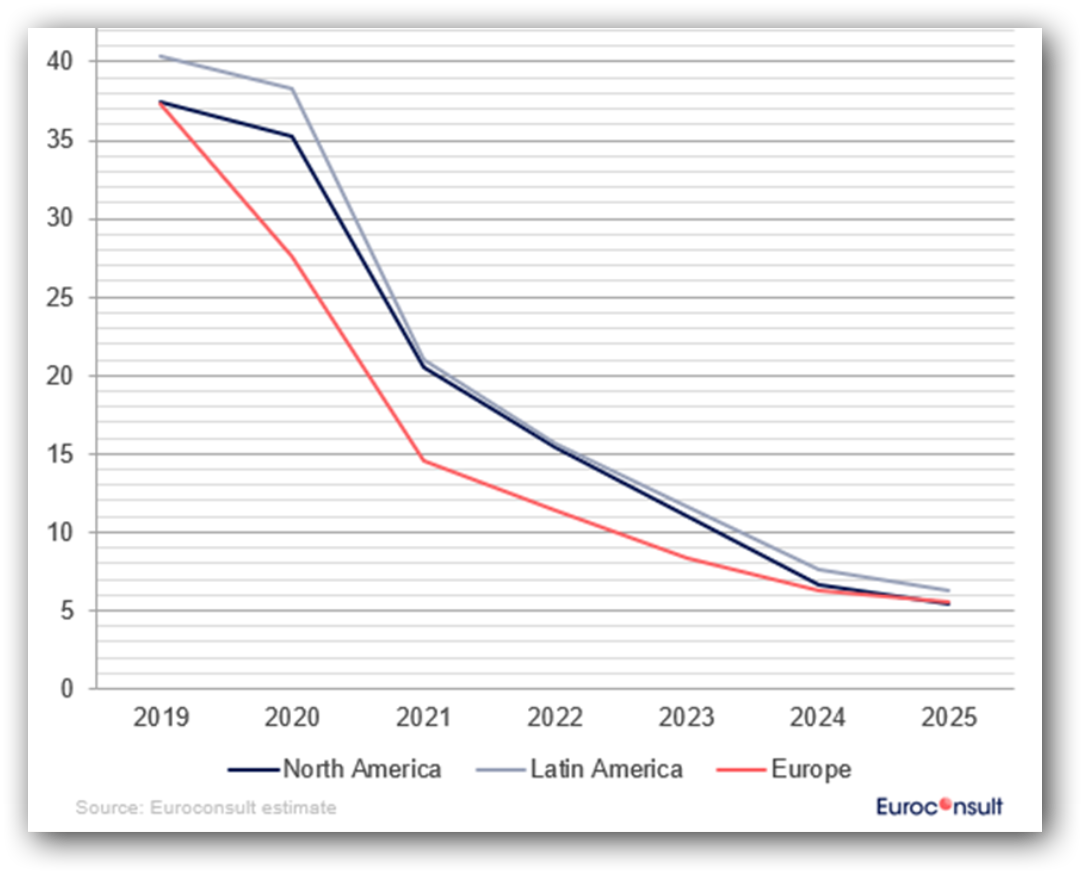
Source: SpaceNews
These capacity payments continue until December 2027 and may prove difficult to unwind, as Sure could argue that reducing satellite capacity would degrade the broadband service on which islanders now depend. Together with the VSAT compensation payments, they illustrate a pattern of the FIG accepting Sure’s commercial position rather than challenging it more robustly.
They also raise a broader question about public financial management. Long-term subsidies should not become permanent simply because they have existed for several years. As markets, technologies and commercial circumstances change, it is reasonable to ask whether continued public funding remains justified and, if so, at what level. By 2026, the issue is no longer whether additional satellite capacity should be subsidised, but whether the existing subsidy of £262,000 per quarter should itself be reviewed and renegotiated in the public interest.
Starlink Compensation
The VSAT compensation agreement provides perhaps the clearest and most costly example of FIG’s negotiating approach. When FIG legalised Starlink and reduced the VSAT licence fee from £5,400 to £180, Sure threatened legal action. Rather than contesting those claims in court, FIG negotiated an agreement allowing Sure to recover up to £6.166 million from public funds for evidenced broadband revenue losses.
Nearly £1.5 million has already been paid. Together with the continuing broadband capacity subsidy, FIG is now committing an estimated £393,000 each quarter to Sure while the exclusive licence remains in force. The Standing Finance Committee confirmed on 24 June 2026 that if the exclusive licence is extended beyond December 2027, any compensation for that additional period may require fresh negotiations with Sure. No budget assumptions have yet been made for such an extension, despite the possibility having already been identified in the October 2025 ExCo paper.
The PAC had already concluded that FIG’s regulation of Sure lacked sufficient robustness and that public funds had been committed without adequate safeguards. Against that background, the October 2025 compensation agreement raises a broader question about negotiating strategy. Whether a firmer negotiating position could have produced a different outcome cannot now be known, but no evidence has entered the public domain to suggest that this course was pursued.
Given the Falkland Islands’ current fiscal pressures, it is reasonable to ask whether this continuing level of public financial support was subject to sufficiently robust challenge in the public interest.
Public Subsidies for a Profitable Company
FIG’s Starlink compensation agreement was not the only example of continuing public financial support for Sure while the company remained highly profitable. Sure South Atlantic reported revenues of £18.3 million and profits after tax of £5.0 million in 2023. During the same year, it paid a £9 million dividend to its parent company, Beyon (formerly Batelco), following an £8.5 million dividend in 2022.
There is nothing unusual about a profitable company paying dividends to its shareholders. The public policy question is whether continuing public subsidies remained justified when the recipient was generating sufficient profits to distribute millions of pounds to its parent company.
The public record contains no indication that these subsidy arrangements were reconsidered in light of Sure’s continuing high profitability. Whether FIG should have continued subsidising the company under those circumstances is ultimately a matter of public policy and public accountability. It is a question that deserves careful consideration as decisions are made about the future structure of telecommunications in the Falkland Islands.
The Same Pattern, A Different Arena
Cruise passengers can enjoy Starlink connectivity throughout their voyage. Yet when they step ashore in Stanley, that connectivity disappears, despite Starlink now being legal for individual use within the Falkland Islands. A vessel using Starlink at sea requires no Falklands VSAT licence, while small guest houses offering the same service to guests remain subject to licensing restrictions and potential penalties of up to £125,000.
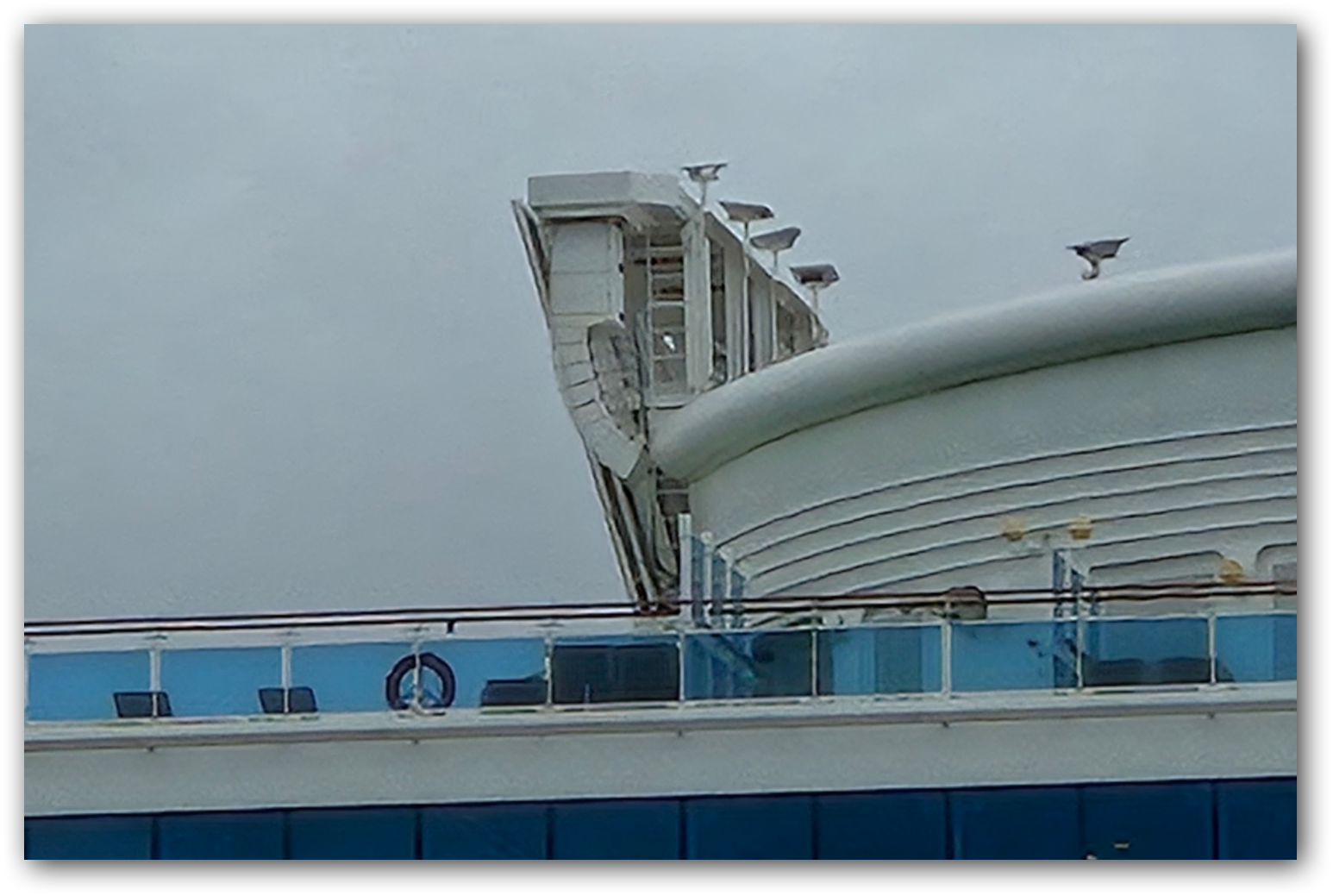
This outcome did not arise solely through negotiation. Sure’s exclusive licence created genuine legal constraints, and the Communications Regulator concluded there was no realistic scope for change before January 2028.
The result, however, is a dual system. Businesses may use Starlink internally for staff communications, payment systems and office operations, but customer-facing connectivity remains reserved for Sure. While legally understandable, the arrangement limits opportunities to improve the visitor experience and places a disproportionate burden on sectors such as tourism.
Again, whether greater flexibility could have been achieved within the existing legal model remains open to debate. What is clear is that the resulting arrangements align more closely with preserving the existing market structure and benefiting Sure rather than supporting the key needs of the islands’ businesses.
What August ExCo paper Might Bring
Taken individually, each of these examples could be explained by its own circumstances. Considered together, however, they suggest a recurring pattern in how difficult commercial and regulatory telecommunications decisions have been approached.
The August ExCo paper will be the first major test of whether the pattern described in this post continues or demonstrates change. According to the Falklands Radio interview on 22 June 2026, the paper is expected to consider whether to serve notice on Sure and which model should replace the current exclusive licence after December 2027.
There is already evidence that a different approach is possible going forward. When the Starlink petition reached the Legislative Assembly in 2024, MLAs established a Select Committee, examined the evidence in public, acknowledged legal and commercial risks, and nevertheless concluded that the community’s interests justified change. That decision ultimately transformed telecommunications for many islanders.
A post-2027 telecommunications model that simply preserves the existing approach would represent a missed opportunity at a pivotal moment for the Falkland Islands. Equally, a well-supported proposal that demonstrates strategic ambition, commercial discipline, and a clear focus on the long-term public interest would signal something more important than a change in telecommunications policy. It could indicate that FIG has become more confident in confronting difficult telecommunications decisions.

Chris Gare, OpenFalklands, July 2026, copyright OpenFalklands
One Reply to “What the Falkland Islands Government’s Negotiations with Sure Tell Us”