
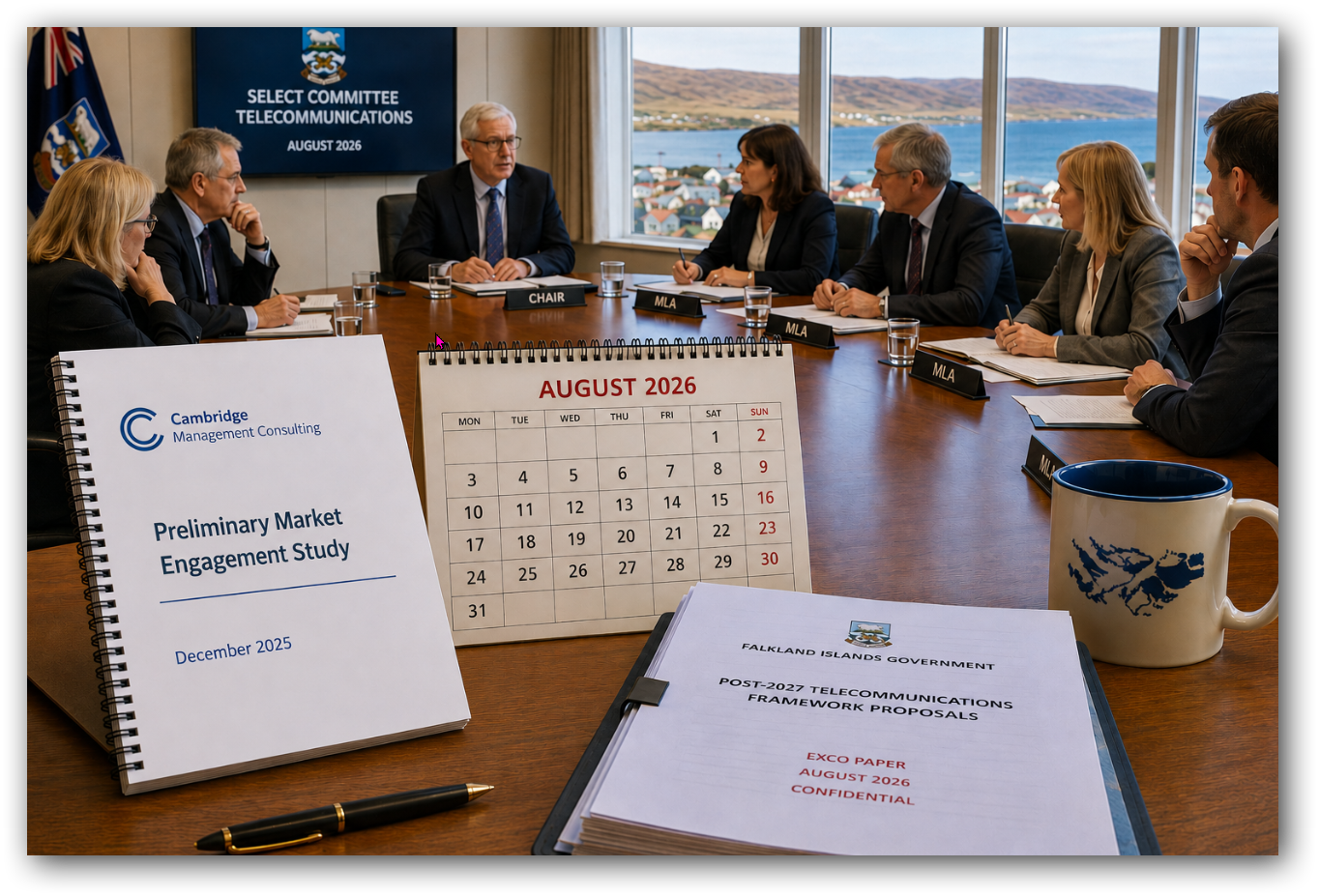
Please note that this is an AI-generated image!
PDF version of the six posts – The case for a Telecommunications Select Committee
Over the past three weeks, OpenFalklands has published four posts examining the financial cost of delay. Together they make a single argument: that what happens in August, when a telecommunications future-after-2017 Falkland Islands Government (FIG) paper is presented to ExCO, will reveal whether a decade of caution has given way to something more confident and decisive.
What the Falklands Government’s 2016 Telecoms Decisions Tells Us About 2026
What the Falkland Islands Government’s Negotiations with Sure Tell Us
£653,000 Every Quarter: The Cost of Delaying Notice to Sure
Falklands Radio Interview Sets the Clock: August and the Case for a Select Committee
Download a PDF document of all 5 posts – here
This post considers what that argument means in practice. Negotiating culture does not switch on when formal talks begin. It has already been shaping the environment in which those talks will take place.
Telecommunications Is Not a Peripheral Service
Before considering how negotiations are already forming, it is worth stating plainly why they matter so much. Telecommunications is not a utility in the background of the Falklands economy. It underpins every part of it — fishing, tourism, financial services, government operations, education, healthcare and Camp connectivity. It shapes whether the Islands can attract investment, retain skilled people and participate fully in a world that is increasingly dependent on reliable, affordable digital connectivity.
The FIG chosen proposal made in August will affect every household, every business and every public service in the Islands for the next decade and beyond. That is why the negotiating culture FIG brings to those decisions deserves as much attention as the policy recommendations themselves.
The Market Is Already Forming a View
During 2025, Cambridge Management Consulting conducted preliminary market engagement to assess potential operators’ interest in the post-December 2027 framework. That exercise was more than a technical assessment. It was also about confidence.
Companies considering entry into a new market are not simply evaluating population size, geography and commercial opportunity. They are also assessing the customer. They want confidence that decisions will be made, that procurement will proceed within a reasonable timescale, and that the organisation leading the process has a clear strategic direction.
More than eighteen months have now passed since the Executive Council approved the revised VSAT policy that legalised Starlink. During that period, further work has continued, but notice under Sure’s exclusive licence has not yet been served. There may be entirely legitimate reasons for that. Telecommunications reform is complex, and careful preparation matters.
Nevertheless, time inevitably sends signals to the market. Delay creates uncertainty, and uncertainty affects commercial confidence. By the time FIG returns to the market, potential participants will not simply be evaluating the opportunity before them. They will also be evaluating the process that brought them there, and forming a view about whether this is an organisation they want to do business with.
The Incumbent Is Forming a View Too
The same principle applies to Sure South Atlantic (Sure).
Negotiations are never conducted in isolation. Every experienced commercial organisation seeks to understand the priorities, constraints and negotiating style of the party sitting across the table. Over the past decade, Sure has observed how FIG has approached major telecommunications decisions. It has seen public funding used to subsidise additional satellite capacity, commercial agreements reached following the threat of legal proceedings, and extended periods of analysis before major structural decisions have been taken.
Whether each of those decisions was right or wrong in its own context is not the issue here. Taken together, they form part of the negotiating environment. They help shape Sure’s expectations about how future negotiations are likely to be conducted.
If one party is perceived as cautious, keen to avoid conflict and inclined to seek negotiated compromise wherever possible, any experienced counterparty will take that assessment into account when deciding its own negotiating strategy. That is not a criticism — it is simply how negotiations work. But it is a reality FIG cannot afford to ignore going into August.
August Is About More Than Telecommunications Policy
None of this tells us what the August ExCo paper will recommend. Nor does it suggest that FIG’s commitment to serve notice and engage the market will not be honoured.
What it does suggest is that organisational culture has consequences long before formal negotiations begin. It influences how potential market entrants assess the opportunity. It influences how the incumbent prepares its negotiating position. And ultimately, it influences the range of achievable outcomes.
The August proposals should therefore be judged on more than their policy recommendations. They should also be judged on whether they demonstrate a genuinely different approach — one that gives both the market and Sure confidence that FIG is prepared to act decisively, negotiate confidently and deliver the long-term telecommunications strategy that the community and the Islands’ economy deserve.
Proper scrutiny should not be seen as an obstacle. Decisions on major infrastructure and public policy are often strengthened through examination by MLAs, giving them greater confidence that the available options have been thoroughly tested before implementation.
That is precisely why the Connected Falklands Group has called on Members of the Legislative Assembly to establish a Select Committee before the post-2027 framework is finalised. A Select Committee would give the community a formal mechanism to scrutinise not just what is being proposed but how it has been negotiated and on what basis. It would demonstrate that the proposals had been subjected to independent parliamentary scrutiny before implementation. And it would give FIG the opportunity to publicly demonstrate that the culture described in recent posts is genuinely changing.
The decision whether to establish a Select Committee now rests with Members of the Legislative Assembly. If there is to be structured public scrutiny before the post-2027 framework is settled, this is likely to be the only realistic opportunity to provide it.

Chris Gare, OpenFalklands, July 2026, copyright OpenFalklands
Shrewd observation: “organisational culture has consequences long before formal negotiations begin”. Thereafter too.
One phrase I make, or try to make about St Helena, including to the Privy Council, comes readily to mind: “… it’s how decisions are made on the island that disenchants Saints most, not the organisational structure or system of representation”.