Two important new pieces of information about the future of Falklands telecommunications have emerged in the last few days. Neither tells Islanders what FIG has decided. Taken together, they suggest work on the post-2027 telecommunications structure is moving forward, while the promised public engagement has still not begun.
The Islands Plan introduces a new word: “framework“
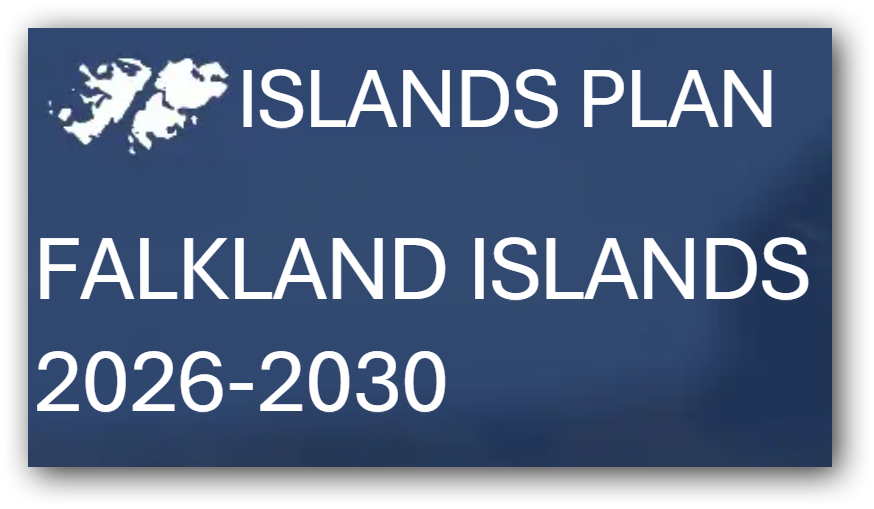
The Falkland Islands Government has now published its Islands Plan 2026-2030. Its single stated objective for telecommunications is brief:
“Develop a framework for future telecommunications provision that will take advantage of new technology to facilitate internal and external communications.”
The word “framework” feels familiar. I used that exact terminology throughout 2026 to describe the overall post-2027 telecommunications settlement. The important question is what FIG itself means by “framework” and, crucially, how much of that framework has already been decided behind closed doors.
A future framework could determine who owns the telecommunications infrastructure, who operates it, which services remain exclusive, where competition is introduced and how investment is funded. It could determine how fibre, mobile networks, Starlink and other LEO satellite services fit together, and how Stanley and Camp are served.
In other words, the decision facing FIG should be about much more than who holds a telecommunications licence after the current licence ends. It should be about what sort of telecommunications market the Falklands wants.
Taking advantage of new technology
The second half of the Islands Plan objective is equally important. FIG says the framework should: “take advantage of new technology”.
The telecommunications world of 2026 is very different from the one in which the current exclusive licence was negotiated around 2016. Starlink has demonstrated what LEO satellite technology can do in remote locations. Modern fibre could replace Stanley’s ageing copper access network. Modern 4G with VoLTE mobile networks can provide both broadband and voice, while local caching and content delivery networks could improve the Internet experience and reduce unnecessary use of expensive international capacity.
Overall, this is a positive statement, as a new framework provides an opportunity to design Falklands telecommunications around today’s technologies and those likely to emerge over the next decade, rather than simply adapting the structure created ten years ago.
Then came MLA Roger Spink’s update
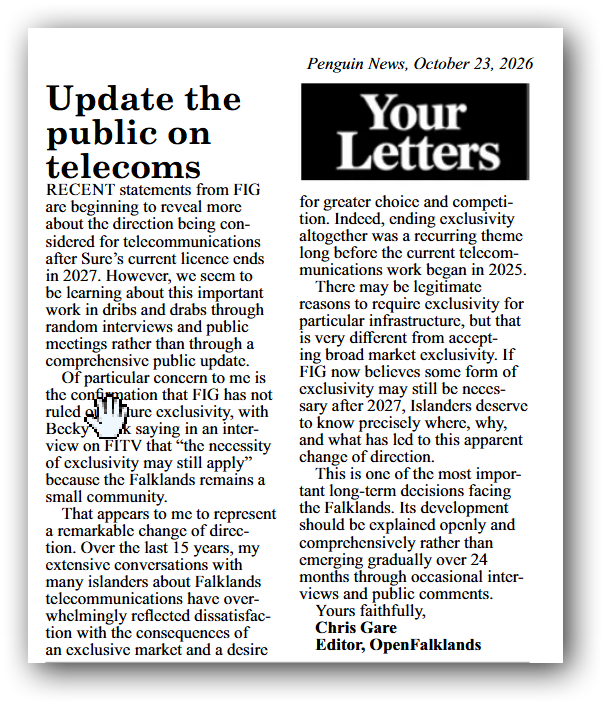
A week after my letter in the 23rd October issue of Penguin News, another piece of the telecommunications jigsaw appeared. In the 30 October edition, MLA Roger Spink said that there had been “considerable progress” on telecommunications. Penguin News reported that he said FIG would look at getting companies interested, but that, given current “geopolitical reasons”, it “isn’t a good time” to do so.
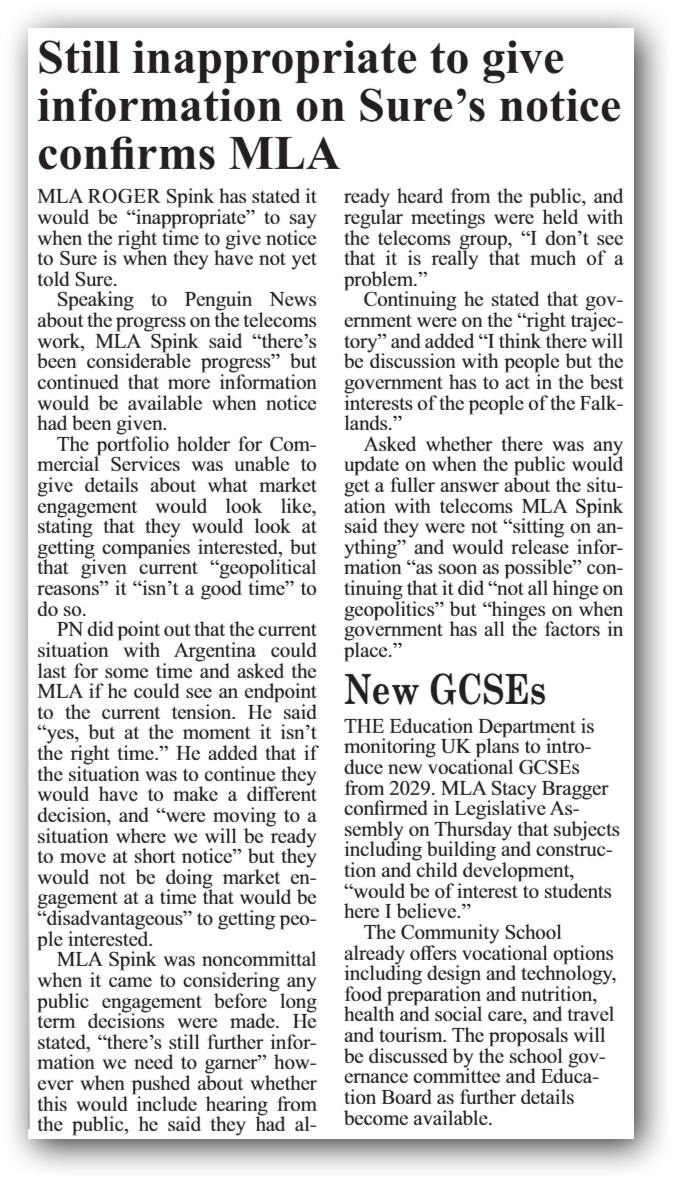

Asked whether he could see an endpoint to the tension, he said: “Yes, but at the moment it isn’t the right time”. Penguin News also reported him saying that if the situation continued, FIG would have to make a different decision, and that it was moving towards a position where it would be “ready to move at short notice”, but would not approach the market at a time that would be “disadvantageous”.
That is partly encouraging. It suggests that the proposed further international process has not been abandoned. But it is also a more cautious signal than it first appears. The timing depends on events FIG has not identified, and his reference to a different decision leaves open the possibility of a change of route if they continue. He did not say what that might be.
But “considerable progress” immediately raises a question: progress towards what? The public already knows that ExCo considered telecommunications behind closed doors in August and that the paper established parameters for giving notice to Sure and for future market engagement.
At the public meeting on 12 October, FIG explained that recent geopolitical events meant those parameters had not yet been met. Now Islanders are told that considerable progress has nevertheless been made. That is not necessarily contradictory. A great deal of work could be taking place while the formal process remains delayed.
But what does “considerable progress” actually mean? Progress on the framework? The future market structure? Discussions with Sure? Infrastructure ownership and exclusivity? Or simply preparation for the next stage?
FIG has already been to the international market
Another important piece of context is that FIG has already approached the international market. Cambridge Management Consulting’s (CMC) Phase 2 Preliminary Market Engagement began in September 2025 and ended in January 2026. Its purpose was specifically to test market interest and identify potential providers willing to operate in, or support, the Falkland Islands.
So when FIG talks about seeking interest from companies once geopolitical circumstances permit, this would not be its first approach to the market. It would be a return to a market that FIG has already tested. That raises an obvious question: what will FIG offer companies this time that it could not offer during the preliminary exercise?
The 2025 exercise was deliberately described as Preliminary Market Engagement. Any further process presumably needs to be much more concrete. And that brings the discussion straight back to the Islands Plan’s new word: framework.
What will companies actually be asked to compete for?
Before FIG goes back to the market, potential participants will need to understand what opportunity is actually being offered. Will companies be invited to operate the whole network? Operate infrastructure owned by somebody else? Invest in new fixed or mobile infrastructure? Provide individual services? Compete alongside Sure or even replace them? And critically, what, if anything, will remain exclusive?
FIG has already confirmed publicly that it has not ruled out future telecommunications exclusivity and is considering if and where exclusivity might be required. Those decisions could profoundly affect which companies are willing to participate and what they might offer.
The framework therefore cannot simply be an administrative wrapper around the international process. It would define the market that FIG is asking companies to compete for.
What did FIG learn the first time?
FIG has released no public information about what it learned from the 2025 Preliminary Market Engagement. Neither the Phase 1 nor the Phase 2 CMC report has been published, though CMC undertook a Phase 1 presentation. That exercise should have provided valuable evidence about international interest, possible operating models, investment requirements and what alternative providers believed was commercially achievable in the Falklands. It would be surprising if that information were not now helping to shape the framework.
A further international exercise could still be extremely valuable. More than a year may separate it from the original PME, and technologies, companies and investment priorities continue to change. It could also provide an important commercial benchmark against which any proposal from Sure could be assessed.
But that only works properly if there remains sufficient room for alternative approaches. If the fundamental market structure has already been substantially determined before companies are approached again, the range of possible solutions may already have been narrowed.
Consultation or communication?
And that leads to perhaps the most important issue. FIG has repeatedly talked about future public engagement on telecommunications. But there is a fundamental difference between consulting Islanders while the important choices remain open and communicating a proposed solution after those choices have largely been made.
A meaningful consultation could address some fundamental questions: Should any telecommunications services remain exclusive after 2027? Who should own the fixed infrastructure? Should infrastructure ownership and service provision be separated? What investment should be required in fibre and mobile networks? How should Camp connectivity be provided? What role should LEO operators play? What resilience, open access and performance obligations should apply?
These aren’t minor technical details. They are fundamental choices about how Falklands telecommunications could operate for another decade or more.
The information is still arriving in dribs and drabs
Once again, information about one of the most important infrastructure decisions facing the Falklands is emerging in dribs and drabs. A closed ExCo paper. A short ExCo summary. Comments at a public meeting. An interview about exclusivity. A single sentence in the 2026-2030 Islands Plan. And now another statement in Penguin News.
Gradually, pieces of the jigsaw are appearing. But Islanders still haven’t been shown the picture on the box. FIG may have perfectly reasonable commercial or geopolitical reasons for not disclosing everything that is happening. Nobody should expect negotiations with individual companies to be conducted in public.
But commercial confidentiality and public policy are not the same thing. FIG can explain the different market structures it is considering without revealing commercially sensitive negotiations. Indeed, if FIG really is developing a new framework for future telecommunications provision, surely now is precisely the time for that public discussion.
Because once the framework has largely been designed, consultation risks becoming little more than communication. And Roger Spink’s statement that “considerable progress” has already been made makes the timing of that discussion increasingly important.
The question now is: for how long can the future of Falklands telecommunications continue to be developed behind closed doors?

Chris Gare, OpenFalklands, November 2026, copyright OpenFalklands